|
Amir Reza Vazifeh I'm a PhD student in Electrical and Computer Engineering at Princeton University, where I work in the Imaging Physics Lab under the supervision of Professor Jason Fleischer. I also collaborate with the Computational Imaging Lab, supervised by Professor Felix Heide. My current research focuses on Computational Imaging and Optics, Computer Vision, Neural Rendering, and AI in healthcare and medicine. |

|
Research
|
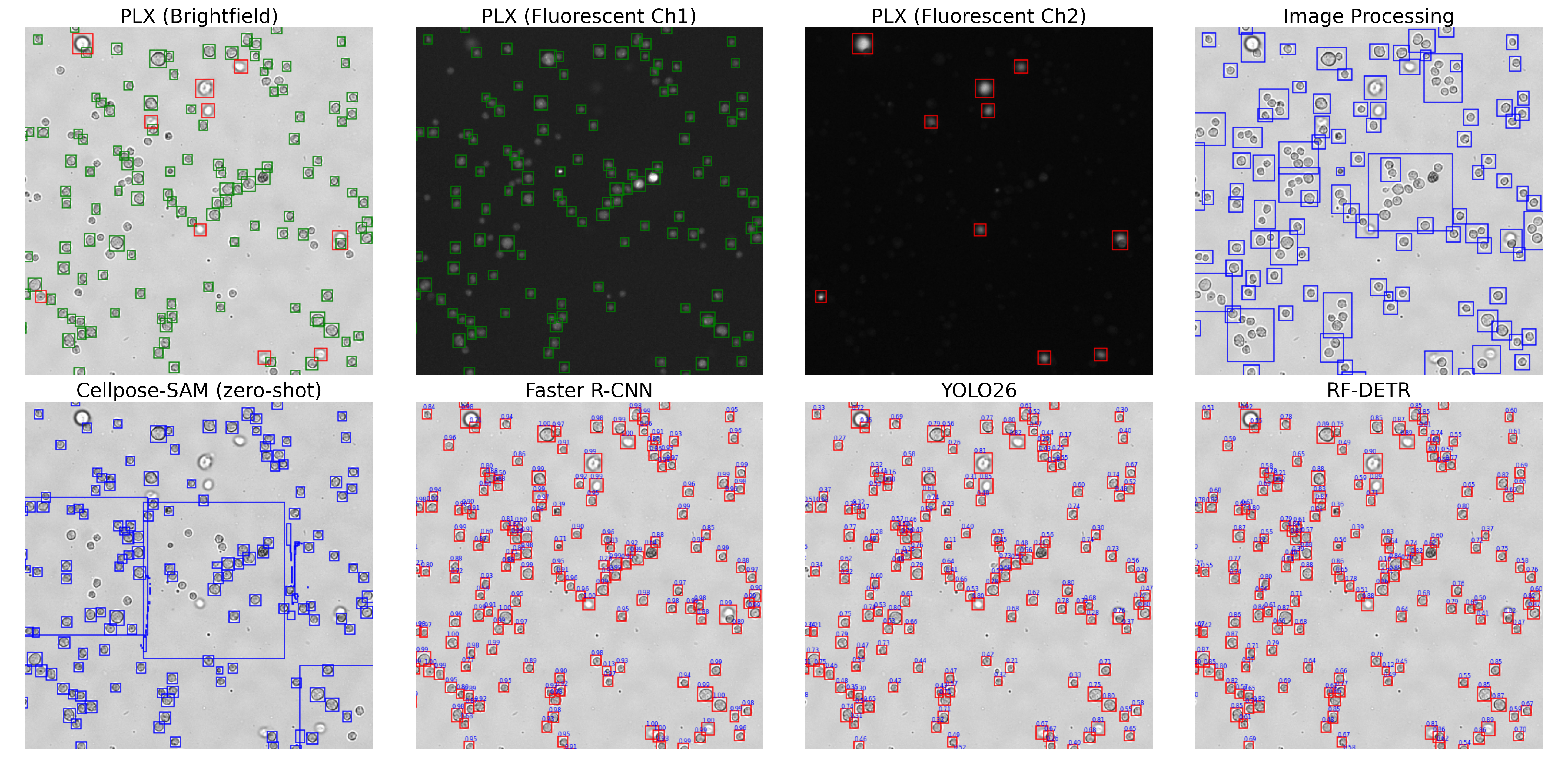
Label-free Cell Counting and Viability Prediction with Brightfield Imaging and Deep Learning
Amir Reza Vazifeh, Christian Zeigler, Sornanathan Meyyappan, Richard Jeske, Jason W. Fleischer Under Review 2026 project page / preprint / software demo Live and dead cells show distinct morphological signatures in brightfield images, and a model trained on stained cells generalizes to unstained ones. Building on this, we present Viabilense, a deep learning pipeline for label-free cell counting and viability prediction. |

|
Neural Fields for Single-Shot Image Reconstruction in Fiber Bundle Imaging Systems
Amir Reza Vazifeh, Jason W. Fleischer Frontiers in Optics 2026 publication (TBA) / poster / code We pose fiber bundle image reconstruction as an inverse problem, where the measurement is a blurred, fiber-masked version of the underlying scene. The high-resolution image is then recovered by optimizing a coordinate-based network at test time. |

|
AI-Enabled Label-Free Cell Viability Assessment from Brightfield Imaging
Amir Reza Vazifeh, Christian Zeigler, Sornanathan Meyyappan, Richard Jeske, Jason W. Fleischer Frontiers in Optics 2026 publication (TBA) We present an AI-based method for cell viability assessment directly from brightfield images, without staining or fluorescent imaging. We demonstrate its efficiency in CHO cells under a wide range of viability conditions. |

|
Manifold Alignment for Label-Free Cell Phenotyping in Multimodal Microscopy
Amir Reza Vazifeh, Jason W. Fleischer Microscopy, Histopathology and Analytics, Optica Biophotonics Congress 2026 publication / code We presented a dimensionality-reduction framework for multimodal microscopy that integrates information from different imaging modalities into a shared low-dimensional manifold and demonstrated its effectiveness for live/dead cell phenotyping. |

|
Seeing Through Fibers: Unsupervised Image Reconstruction in Fiber Bundle Imaging Systems
Amir Reza Vazifeh, Congli Wang, Amogh Joshi, Ilya Chugunov, Jipeng Sun, Jiwoon Yeom, Jason W. Fleischer, José S. Pulido, Felix Heide Optics Express 2026 project page / publication / code We introduce an unsupervised method with implicit neural representation that reconstructs high-resolution fiber bundle images from misaligned bursts without calibration or paired data. |

|
An Open-Source Analysis of Cardiomyopathy Using Machine Learning and Electrocardiograms
Arda Altintepe, Asu Rustemli, Amir Reza Vazifeh, Jason W. Fleischer Diagnostics 2026 publication / code We developed an open-source ECG-based machine learning pipeline to distinguish hypertrophic from dilated cardiomyopathy subtypes using standard and vectorcardiogram features. |

|
Manifold Learning for Personalized and Label-Free Detection of Cardiac Arrhythmias
Amir Reza Vazifeh, Jason W. Fleischer Informatics in Medicine Unlocked 2026 project page / publication / software demo We use nonlinear dimensionality reduction for unsupervised, personalized heartbeat phenotyping from ECGs and arrhythmia detection. |

|
Snapshot Hyperspectral Imaging via Compressive Sensing and Implicit Neural Representation
Jatearoon Boondicharern, Amir Reza Vazifeh, Jason W. Fleischer Computational Optical Sensing and Imaging, Optica Imaging Congress 2025 publication / code We propose a snapshot hyperspectral imaging method using randomized aperture codes and implicit neural representations. |

|
Advancing personalized healthcare and entertainment: Progress in energy harvesting materials and techniques of self-powered wearable devices
Prithu Bhatnagar, Sadeq Hooshmand Zaferani, Nassim Rafiefard, Bardia Baraeinejad, Amir Reza Vazifeh, Raheleh Mohammadpour, Reza Ghomashchi, Harald Dillersberger, Douglas Tham, Daryoosh Vashaee Progress in Materials Science 2023 publication We reviewed recent advances in self-powered wearable devices, covering energy harvesting techniques, power management, and their application in long-term health and wellness monitoring. |

|
Design and Implementation of an Ultralow-Power ECG Patch and Smart Cloud-Based Platform
Bardia Baraeinejad, Masood Fallah Shayan, Amir Reza Vazifeh, Diba Rashidi, Mohammad Saberi Hamedani, Hamed Tavolinejad, Pouya Gorji, Parsa Razmara, Kiarash Vaziri, Daryoosh Vashaee, Mohammad Fakharzadeh IEEE Transactions on Instrumentation and Measurement 2022 publication We developed an ultra-low-power, lightweight ECG patch for long-term monitoring, paired with an AI-assisted cloud platform for denoising and arrhythmia detection. |
Miscellanea
Honors &
|
ECE Graduate Student Award for Excellence in Service [News] — Princeton University, 2026 Ph.D. Fellowship in Natural Sciences and Engineering — Princeton University, 2023 Academic Achievement Award — Sharif University of Technology, 2019–2020 Ranked 12th among 134,000+ applicants in the Iranian University Entrance Exam (Konkour), 2018 |
Teaching &
|
Princeton ECE 452: Biomedical Imaging — Assistant in Instruction, Spring 2025 & 2026 Princeton ECE 435/535: Machine Learning and Pattern Recognition — Assistant in Instruction, Fall 2024 Princeton Laboratory Learning Program (LLP) — Mentoring high school students, Summer 2025 |
Review |
IEEE Journal of Biomedical and Health Informatics Springer Nature Journal of Supercomputing |
Hobbies |
My Global Footprint — an interactive map of countries I've visited and lived in. Entertaining Visualization — During my PhD, I made some videos to better understand how optimization algorithms converge to their solutions. Some of them turned out to be entertaining, so I'm sharing them here. |